ISO/IEC 27001 is the internationally recognised standard for establishing, implementing, maintaining, and continually improving an Information Security Management System (ISMS).


Published by the International Organization for Standardization (ISO) and the International Electrotechnical Commission (IEC), the standard provides a structured framework for managing information security risks across an organisation.
For organisations responsible for delivering critical services, operating complex technology environments, or managing sensitive information, cyber security incidents can have consequences that extend well beyond technology disruption.
Impacts may include service outages, operational disruption, loss of sensitive information, regulatory obligations, financial loss, and reputational harm.
ISO 27001 provides a systematic approach for understanding and managing these risks through governance, risk management, security controls, and continual improvement activities.
At the core of ISO 27001 is a risk-based approach that enables organisations to identify information security risks, assess their potential impact, implement appropriate controls, and monitor their effectiveness over time. This allows security activities to be aligned with business priorities, operational requirements, and organisational risk tolerance.
ISO 27001 is widely adopted across critical infrastructure sectors, government agencies, healthcare providers, financial institutions, technology companies, and organisations responsible for protecting sensitive personal, commercial, operational, or customer information.
The standard provides a recognised framework for managing information security risks while supporting governance, resilience, and assurance objectives.
Overcyte helps organisations operationalise ISO 27001 by bringing assessments, risks, controls, evidence, remediation activities, and reporting together within a single platform.
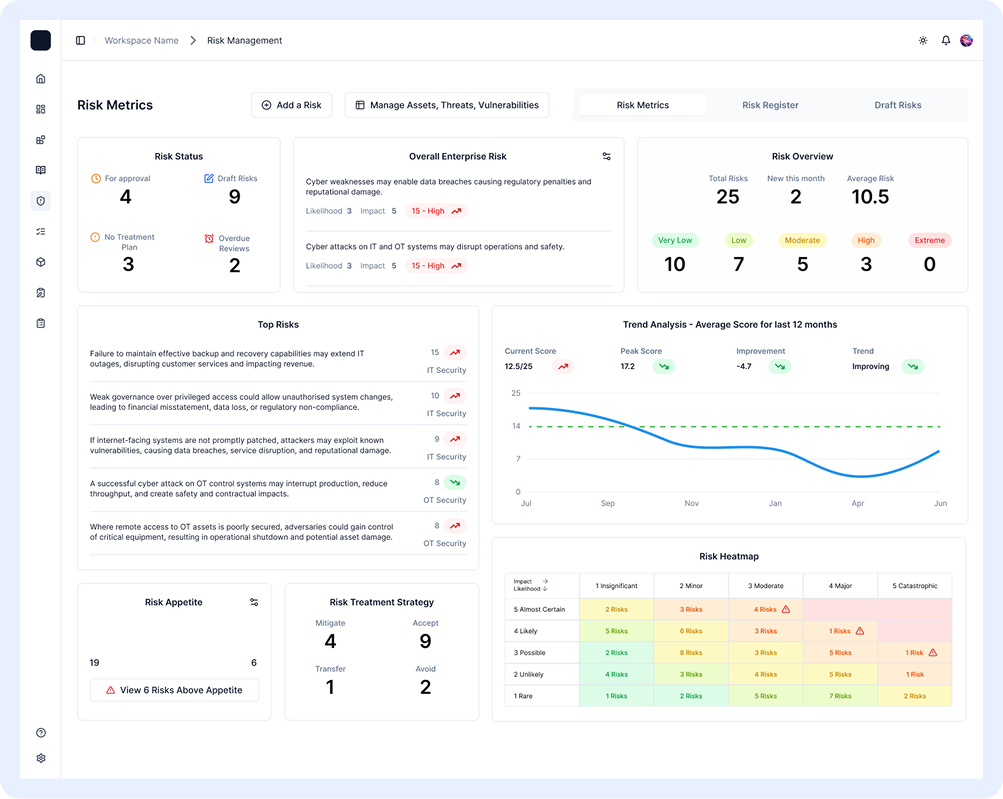
Through contextualised risk management capabilities, organisations can align information security activities with critical services, sensitive information, operational processes, and business objectives while maintaining visibility of progress over time.
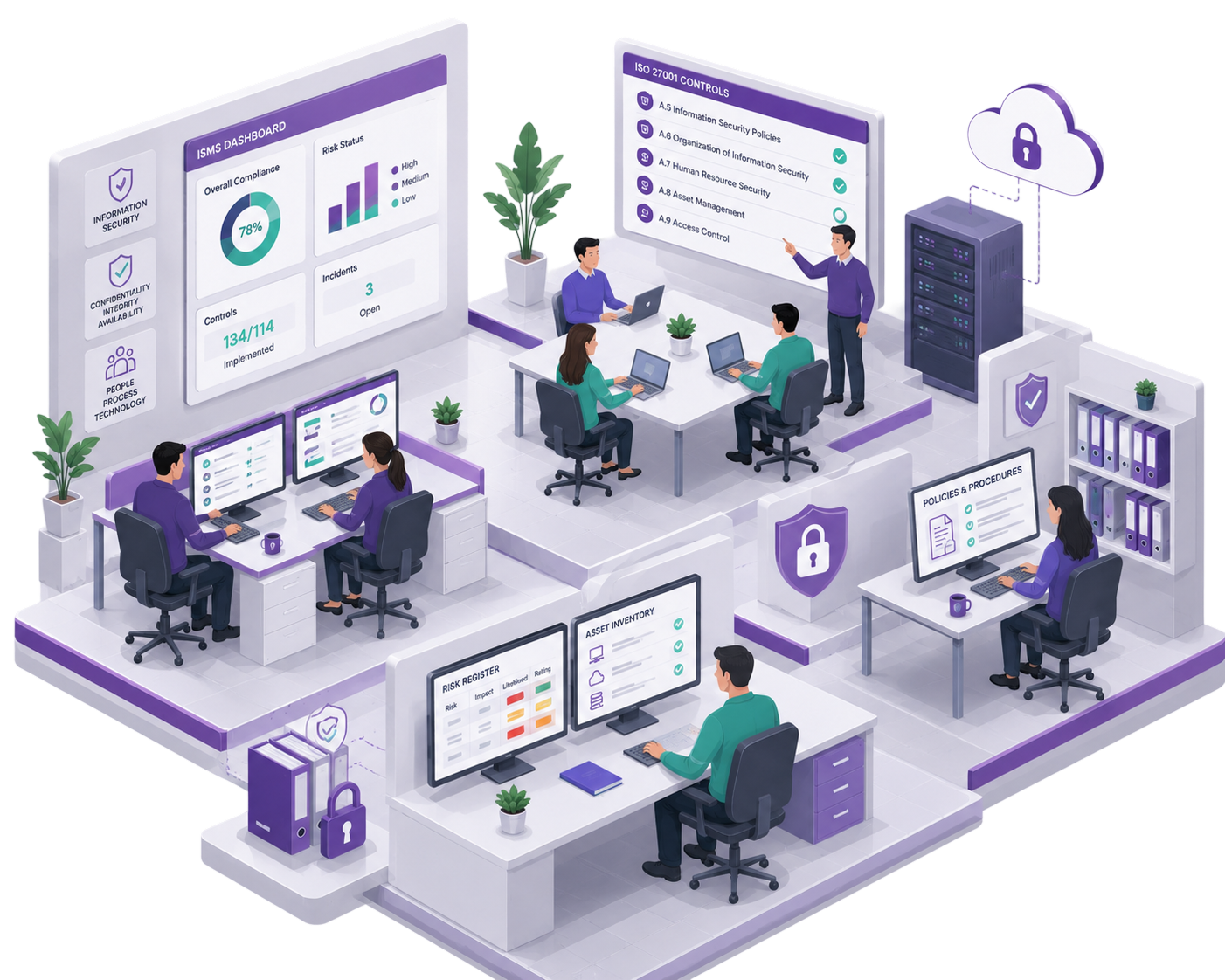
ISO 27001 establishes the requirements for an Information Security Management System (ISMS). The standard follows a management system approach that integrates governance, risk management, security controls, performance measurement, and continual improvement activities. The standard is structured into a number of clauses that define the requirements for establishing, operating, maintaining, and improving an ISMS.
This clause requires organisations to understand the internal and external factors that influence information security, identify interested parties, determine business requirements, and define the scope of the ISMS.
The Leadership clause focuses on executive commitment, governance, accountability, information security policy, and the assignment of organisational roles and responsibilities.
Planning requires organisations to identify information security risks and opportunities, establish security objectives, and determine how risks will be managed through appropriate treatment activities.
The Support clause addresses the resources, competence, awareness, communication, and documented information required to operate and maintain the ISMS.
Operation focuses on implementing risk treatment activities, managing information security processes, and ensuring controls operate as intended.
This clause requires organisations to monitor, measure, analyse, evaluate, audit, and review the effectiveness of the ISMS and supporting controls.
Improvement focuses on addressing nonconformities, implementing corrective actions, and continually improving the effectiveness of the information security management system.
Together, these clauses provide a structured framework for managing information security risks across business, technology, operational, and data environments.
Information Security Management System (ISMS)
The ISMS is the central component of ISO 27001. It provides a structured approach for managing information security risks through governance, policies, procedures, controls, monitoring activities, and continual improvement processes.The ISMS enables organisations to align information security activities with business objectives while maintaining visibility of risks, responsibilities, and security outcomes.
Risk Assessment and Risk Treatment
ISO 27001 requires organisations to establish and maintain information security risk assessment and risk treatment processes.Risk assessment activities are used to identify threats, vulnerabilities, impacts, and risks that could affect information assets, business processes, critical services, systems, and technology environments.Risk treatment activities determine how identified risks will be managed, including the selection, implementation, and monitoring of security controls.
Annex A Controls
ISO 27001 includes Annex A, which provides a reference set of information security controls. The current version of the standard contains 93 controls grouped into four themes.
Organisational Controls
Controls relating to governance, policies, supplier relationships, asset management, incident management, and information security responsibilities.
People Controls
Controls relating to personnel security, awareness, training, background screening, and employee responsibilities.
Physical Controls
Controls relating to facilities, equipment, physical access, environmental protections, and physical security management.
Technological Controls
Controls relating to identity management, access control, logging, monitoring, cryptography, vulnerability management, network security, and system protection.
Statement of Applicability (SoA)
The Statement of Applicability is a key ISO 27001 document that records which Annex A controls have been selected, the justification for their inclusion or exclusion, and their implementation status.
Together, the ISMS, risk management processes, Annex A controls, and Statement of Applicability provide the foundation for implementing and maintaining ISO 27001.
ISO 27001 is a certifiable international standard. Certification is performed by accredited certification bodies and provides independent assurance that an organisation's Information Security Management System conforms to the requirements of the standard.
For organisations operating critical services or managing sensitive information, certification activities can also provide stakeholders, customers, regulators, and business partners with confidence that information security risks are being managed through a structured and recognised framework.
The standard establishes governance mechanisms, accountability structures, and risk management processes that support informed decision making and organisational oversight.
For organisations delivering critical services or operating complex technology environments, this enables information security activities to be aligned with operational priorities and business objectives.
The standard provides a comprehensive framework for protecting information assets through organisational, people, physical, and technological controls.
This supports the protection of sensitive personal information, commercial information, operational information, customer data, and other information assets that are critical to organisational operations and service delivery.
ISO 27001 promotes a risk-based approach that helps organisations understand dependencies, vulnerabilities, and risks that may affect critical processes and services.
Through governance, risk management, incident management, supplier management, and continual improvement, organisations can strengthen their ability to manage and respond to security-related disruptions.
ISO 27001 is widely recognised by regulators, customers, suppliers, and business partners.
Many organisations use the standard to support assurance programmes, procurement requirements, contractual obligations, and regulatory expectations relating to information security.
The standard also provides a common foundation that can be mapped to other frameworks, standards, and industry-specific requirements.
Continual improvement is a core principle of ISO 27001.
Organisations are required to monitor performance, conduct audits, review outcomes, address nonconformities, and improve the effectiveness of security activities over time.
This supports the ongoing evolution of cyber security capabilities as technologies, business requirements, and threat environments continue to change.
Overcyte provides a structured platform for managing ISO 27001 implementation activities, Information Security Management Systems, risk assessments, and continual improvement programmes. The platform enables organisations to assess current capabilities, identify gaps, document evidence, manage remediation activities, and monitor progress against ISO 27001 requirements over time.
At the core of the platform is a contextualised risk management capability that enables organisations to understand how information security risks relate to critical services, sensitive information, operational processes, technology assets, suppliers, and business objectives. Rather than treating ISO 27001 as a documentation exercise, Overcyte enables organisations to link security activities directly to risk reduction and organisational resilience outcomes.
Overcyte's Controls Library provides a central repository for managing ISO 27001 controls, Annex A controls, policies, standards, procedures, evidence, and supporting documentation. Controls can be mapped directly to risks, assessments, audit findings, remediation activities, and business objectives, creating traceability between security requirements, implementation activities, and risk outcomes.
The platform also supports Statement of Applicability management, risk treatment planning, internal audit activities, remediation tracking, reassessments, and ongoing monitoring. Organisations can maintain visibility of control effectiveness, track risk reduction, manage findings, and demonstrate progress over time.
By bringing together assessments, risks, controls, actions, evidence, audits, and reporting within a single platform, Overcyte provides a structured and repeatable approach to implementing ISO 27001 across critical infrastructure operators, essential service providers, sensitive data environments, and complex technology ecosystems.