The NIST Cybersecurity Framework (NIST CSF) is a globally recognised cyber security framework developed by the National Institute of Standards and Technology (NIST).
Originally created to support critical infrastructure operators, the framework is now widely adopted by organisations across a broad range of industries to manage and reduce cyber security risk.


NIST CSF provides a structured and outcome-focused approach to cyber security by helping organisations identify, assess, manage, and communicate cyber security risks.
The framework establishes a common language that enables technical teams, executives, boards, regulators, and external stakeholders to understand cyber security priorities and make informed risk-based decisions.
The framework is designed to be flexible and scalable, enabling organisations to apply it across information technology (IT), operational technology (OT), cloud services, third-party ecosystems, and complex digital environments.
Rather than prescribing specific technologies or controls, NIST CSF focuses on the outcomes organisations should achieve to manage cyber security risk effectively.
NIST CSF is widely used across critical infrastructure sectors, including energy, utilities, transportation, healthcare, telecommunications, government, manufacturing, and organisations responsible for managing sensitive information or complex technology environments.The framework supports organisations in understanding their current cyber security posture, defining target outcomes, and prioritising improvement activities based on risk.
Overcyte helps organisations operationalise NIST CSF by bringing assessments, risks, controls, evidence, remediation activities, and reporting together within a single platform.
Through contextualised risk management, organisations can align cyber security activities with critical assets, operational processes, business objectives, and risk management priorities while maintaining visibility of progress over time.

NIST CSF 2.0 is organised around six Core Functions that represent the key outcomes required to manage cyber security risk. Together, these Functions provide a structured approach to governance, protection, detection, response, and recovery activities across an organisation.
The Govern Function provides the foundation for cyber security risk management. It focuses on organisational strategy, policy, roles and responsibilities, risk management processes, oversight, and supply chain risk management activities. Governance activities help ensure cyber security decisions are aligned with organisational objectives, legal obligations, and risk tolerance.
The Identify Function focuses on understanding the organisation and the systems, assets, data, services, and processes that support business operations. It includes asset management, business environment analysis, risk assessment, and risk management activities that provide the basis for prioritising cyber security investments and actions.
The Protect Function defines safeguards that support the delivery of critical services and reduce the likelihood or impact of cyber security events. This includes identity management, access control, awareness and training, data security, platform security, technology resilience, and protective technologies.
The Detect Function focuses on identifying cyber security events and anomalous activity in a timely manner. It includes continuous monitoring, event analysis, threat detection, and processes that enable organisations to identify potential incidents before they escalate.
The Respond Function addresses activities undertaken following the detection of a cyber security incident. It includes incident response planning, communications, analysis, containment, mitigation, and coordination activities designed to manage and reduce the impact of incidents.
The Recover Function focuses on restoring capabilities, services, and operations following a cyber security incident. It includes recovery planning, communications, restoration activities, and continuous improvement processes designed to strengthen organisational resilience over time.
Together, the six Functions provide a comprehensive structure for managing cyber security risk throughout the lifecycle of an organisation's systems, services, and operations.
The NIST Cybersecurity Framework Core consists of Functions, Categories, and Subcategories.
The six Functions describe the primary cyber security outcomes organisations seek to achieve. Each Function is divided into Categories that group related cyber security activities, while Subcategories provide more detailed outcomes that organisations can use when assessing capabilities and identifying improvement opportunities.
This structure provides a consistent framework for understanding current capabilities, identifying gaps, and prioritising cyber security improvements.
Profiles are used to align cyber security activities with organisational requirements, risk tolerance, and business objectives.
Current Profile
The Current Profile represents the cyber security outcomes currently being achieved by the organisation. It provides a baseline view of existing capabilities and helps identify strengths, weaknesses, and areas requiring improvement.
Target Profile
The Target Profile represents the desired future state. It reflects the outcomes the organisation intends to achieve based on business priorities, operational requirements, regulatory obligations, and risk management objectives.
Comparing the Current Profile with the Target Profile enables organisations to identify gaps, prioritise remediation activities, and develop structured improvement roadmaps.
Implementation Tiers provide context regarding how an organisation manages cyber security risk. They are intended to help organisations understand the maturity and sophistication of their risk management practices.
Tier 1 – Partial – Cybersecurity risk governance and management practices are informal, ad hoc, or applied inconsistently.
Tier 2 – Risk Informed – Cybersecurity risk governance and management practices are informed by risk objectives, but may not be consistently implemented across the organisation.
Tier 3 – Repeatable – Cybersecurity risk governance and management practices are formally established, documented, and consistently implemented.
Tier 4 – Adaptive – Cybersecurity risk governance and management practices are adapted and improved based on lessons learned, metrics, and changes in risk.
Unlike some cyber security standards, NIST CSF does not include a formal certification programme administered by NIST. Instead, the framework is commonly used as the basis for assessments, maturity reviews, cyber security programmes, and continuous improvement initiatives.
NIST CSF provides a structured approach to identifying, assessing, prioritising, and managing cyber security risks.
The framework helps organisations align cyber security activities with business objectives, operational requirements, and risk management practices, enabling more informed decision making and prioritisation of resources.
By focusing on outcomes rather than prescribed technologies, NIST CSF enables organisations to implement risk management practices appropriate to their size, complexity, and operating environment.
The framework establishes a common language for communicating cyber security risks across technical teams, executives, boards, regulators, and external stakeholders.
This supports more effective governance by improving visibility of risks, priorities, dependencies, and improvement activities.
The introduction of the Govern Function in NIST CSF 2.0 further emphasises the importance of governance, accountability, and organisational oversight in managing cyber security risk.
NIST CSF addresses cyber security outcomes across governance, protection, detection, response, and recovery activities.
This enables organisations to develop capabilities that support resilience before, during, and after cyber security incidents.
The framework supports the establishment of processes and capabilities that help organisations understand critical services, manage dependencies, respond to incidents, and recover operations in a structured manner.
NIST CSF is widely recognised and adopted across critical infrastructure sectors and highly regulated industries.
Organisations frequently use the framework to support cyber security programmes, supplier assurance activities, internal assessments, procurement requirements, and regulatory obligations.
The framework also provides a common reference point that can be mapped to other standards and industry requirements, helping organisations reduce duplication and improve consistency across cyber security initiatives.
NIST CSF is designed to be applied across diverse technology environments and organisational structures.
The framework can be used to manage cyber security risks across information technology, operational technology, cloud services, third-party providers, digital supply chains, and hybrid environments.
This flexibility makes NIST CSF particularly relevant for critical infrastructure operators, organisations managing sensitive information, and businesses operating complex or highly interconnected technology environments.
Overcyte provides a structured platform for managing NIST CSF assessments, implementation activities, and continuous improvement programmes. The platform enables organisations to assess current capabilities, establish target profiles, identify gaps, document evidence, manage remediation activities, and monitor progress against framework outcomes over time.
At the core of the platform is a contextualised risk management capability that enables organisations to understand how NIST CSF outcomes relate to their specific operational environment. Rather than treating framework implementation as a compliance exercise, Overcyte enables organisations to link cyber security risks to critical assets, sensitive information, operational processes, business services, and organisational objectives. This provides greater visibility of risk exposure and supports more informed prioritisation of remediation activities.
Overcyte's Controls Library provides a central repository for managing controls, evidence, policies, standards, procedures, and supporting documentation. Controls can be mapped to NIST CSF Functions, Categories, and Subcategories, creating traceability between framework outcomes, implementation activities, risks, and supporting evidence. This enables organisations to maintain visibility of control effectiveness while supporting assessments, audits, and continuous improvement activities.
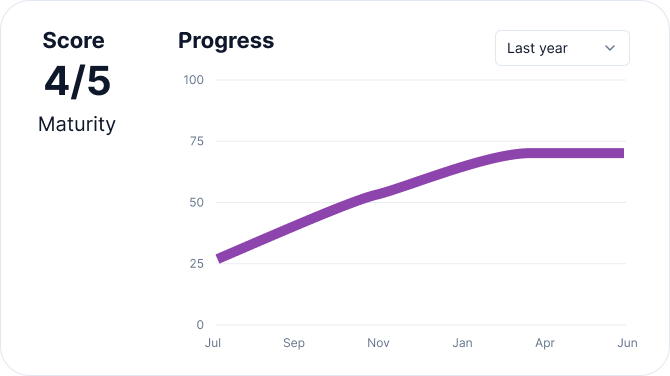
The platform also supports the management of Current Profiles, Target Profiles, gap assessments, improvement roadmaps, and reassessments over time. Organisations can monitor progress against objectives, track remediation activities, measure changes in capability, and maintain a record of decisions and supporting evidence.
By bringing together assessments, risks, controls, actions, evidence, and reporting within a single platform, Overcyte provides a structured and repeatable approach to managing NIST CSF implementation across critical infrastructure, sensitive data environments, and complex technology ecosystems.