Regulation
UK Government sets out 4 year strategy to defend energy sector from cyber threats

Key Insights
- UK Government publishes a four‑year strategy aimed at strengthening cyber security across the nation's energy infrastructure
- A secure energy system is judged to be 'fundamental to national security'
- UK highlights the attractiveness of energy as a target by 'high capability state actors'
- Europe's original Network and Information Systems (NIS) regulations (2018) were strengthened with NIS2 and are driving UK efforts to align
- Four agencies will join forces to protect the electricity, gas and oil sectors - the Department for Energy Security and Net Zero, regulator Ofgem, NCSC and the National Energy System Operator
- Ransomware is a major concern and attacks on industrial control systems are escalating due to rising geopolitical tensions
- The sector is rapidly evolving due to Net Zero objectives, a surge in renewables and grid decarbonisation
"Energy touches the heart of everyone’s lives in this country. It heats our homes, powers our businesses, fuels our economy and underpins the services we rely on every day."
Rt Hon Michael Shanks MP, Minister for Energy, Department of Energy Security and Net Zero
By 2030, the UK will have expended significant efforts to strengthen the security of its evolving energy sector as cyber threats escalate against a backdrop of rising geopolitical tensions.
A new Energy Sector Cyber Security Strategy for 2026 to 2030 has been issued to bring four government bodies together as the country faces a significant shortage of security-cleared professionals with a combination of cyber and engineering skills.
Securing the UK energy sector: four priorities
The Government plan sets out four priorities to address:
- cyber security risks to the energy sector are identified, assessed, understood and managed
- cyber security and resilience is increased at pace across the sector, appropriate to the risks faced
- response and recovery plans are in place and tested for cyber incidents, including sophisticated attacks from capable actors
- cyber requirements are expanded in scope and depth, proportionate to the risk faced and keep pace with the evolving threat and system landscape
And with those defining priorities, come clear strategic objectives:
- Improving understanding of threat and vulnerability across the whole energy system
- Rapidly increasing resilience as the sector transitions to clean power
- Strengthening preparedness, response and recovery
- Tightening monitoring, regulation and enforcement
The 'energy quad' to protect UK CNI
The new strategy illustrates the complexity of securing private sector businesses with responsibilities spread across four bodies tackling a rapidly evolving energy sector:
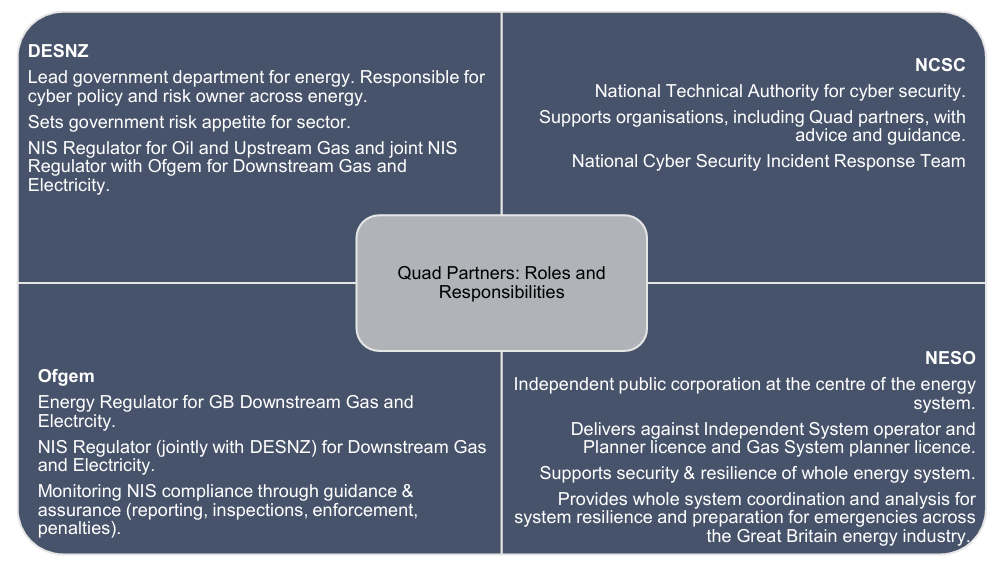
There is a core focus in the strategy to ensure that Government and private sector entities work together and at pace. The document highlights how the usual FVEY adversaries - Russia, China and Iran - are proving to be motivated and highly capable threat actors and a call action must be heeded to prevent network outages and economic harm.
A focus on protecting the Crown Jewels
The four Quad partners will consider what an appropriate cyber resilience roadmap should be to ensure the protection of the energy system’s 'crown jewels' against the advanced threats they face.
An initial target date of of the end of 2027 - just 18 months away - is set out to promote security by design in new energy systems and to re-shape cyber regulation as smaller, more nimble generation layers start to win market share.
All up, the new national strategy sets out 17 SMART goals with firm timelines to protect the UK against the growing energy threat.
There's no explicit mention of additional funding or flow-on costs for the companies involved, but we can expect increased regulation of the UK's energy sector in the years to come as the Cyber Security and Resilience (Network and Information Systems) Bill winds its way through the legislative process.


Similar posts


Identify. Secure. Assure.
.png)