Risk management
How to run a business impact assessment your team can agree on

This article is based on the experience of Aaron Gayton, Founder of Overcyte, who has run and taken part in many business impact assessment workshops. You can read Aaron’s original piece on why BIA workshops get stuck and how a harm scale helps.
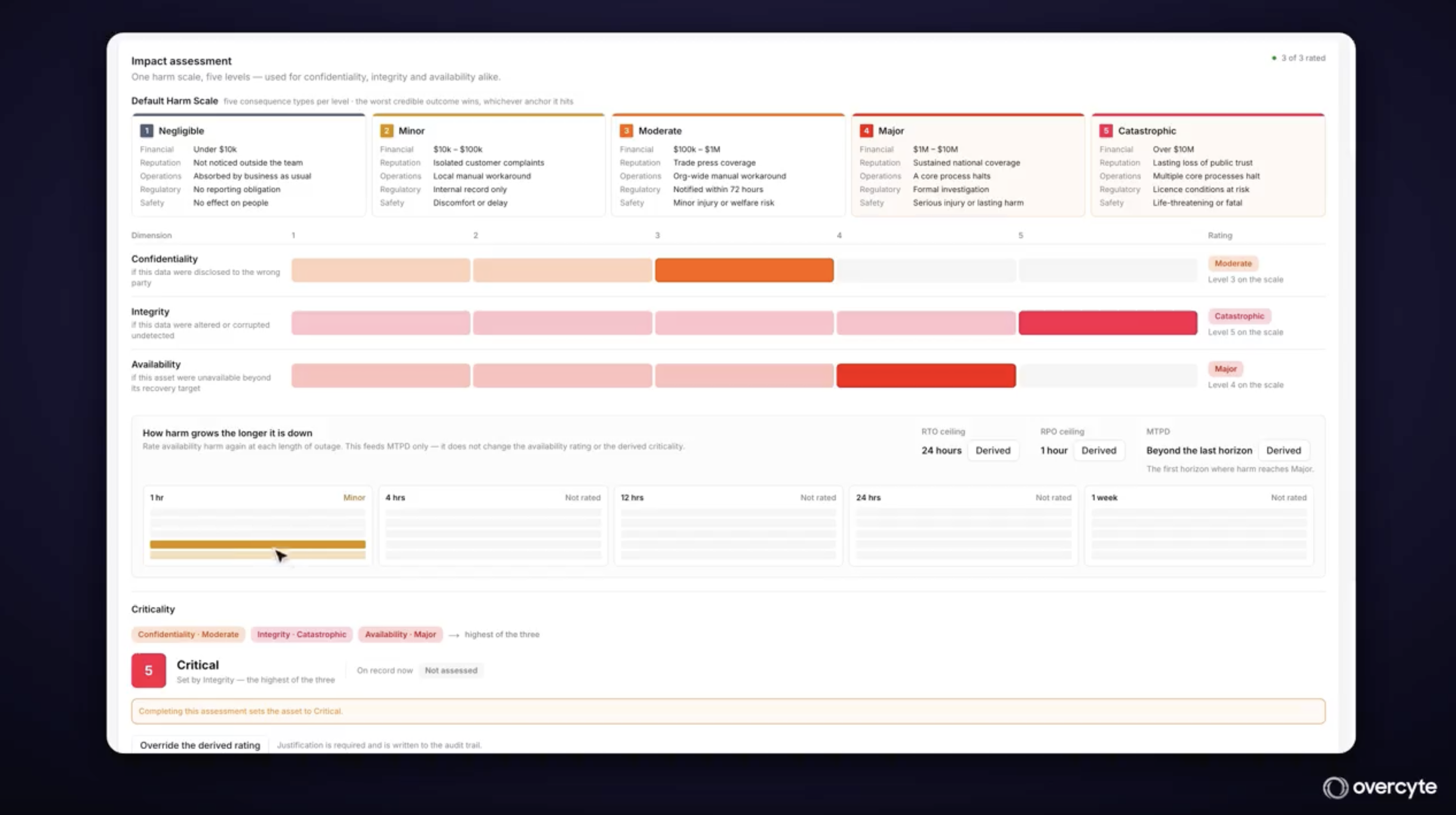
A business impact assessment (BIA) works best when everyone in the room scores against the same definitions. Two things make that possible. The first is the harm scale in your risk management framework, which most organisations already have. The second is a fixed set of outage lengths, such as four hours, one day, one week and one month, that every service is tested against. Used together, they replace one hard question ("is this service critical?") with several smaller ones that people can answer and agree on.
In brief
- Rate harm at several points in time. The same service can be minor at four hours and major at one week.
- Reuse the harm scale from your risk management framework, so BIA results line up with how the board already sees risk.
- The point where harm moves past what the organisation can tolerate sets the recovery target.
- Whether a service is critical depends on the work it carries. Email is the clearest example, and two organisations can reach different answers that are both right.
What a business impact assessment is for
A BIA estimates how much harm the loss of a service or system would cause, and how that harm changes the longer the loss lasts. Its outputs are recovery priorities and recovery targets, which feed directly into business continuity and disaster recovery planning.
For electricity distributors, water utilities, councils and health providers, those targets decide which systems come back first when something fails. That makes the quality of the conversation in a BIA workshop worth getting right.
Where BIA workshops tend to stall
Many BIAs are built around a single question: is this service critical? To answer it, each person has to fold a whole outage into one rating. Some picture a short interruption. Others picture a long one. Much of the disagreement in the room comes from people describing outages of different lengths.
Payroll is a familiar case. One stakeholder says payroll can't be unavailable for more than a day. Another replies that if payroll goes down, the bank can repeat last month's payment and staff are still paid on time.
Both are right, about different moments. The bank workaround covers the first pay run. It does not hold up for the second. By then, new starters haven't been paid, leavers have, and overtime and leave balances can't be reconciled.
Without a shared way to measure harm, the rating usually ends up with whoever is most senior or most confident in the room, rather than with the evidence.
Two tools that settle most disagreements
The harm scale you already use
Most risk management frameworks include a harm scale (sometimes called a consequence scale). It sets out categories such as financial loss, health and safety, service delivery, regulatory and legal, and reputation, and describes each one from minimal through to severe. Because it drives the risk register, the board already reads risk through it.
Scoring the BIA against that same scale has two benefits. Participants measure against written definitions instead of their own sense of what "bad" looks like. And the results sit consistently alongside every other risk rating in the organisation, so recovery priorities can be explained to executives in terms they already use. A separate scale built only for the BIA gives up both of those.
Periods of impact
Periods of impact are fixed outage lengths that each service is tested against. Four hours, one day, one week and one month is a common set. Instead of one verdict, the group answers a series of narrower questions. What harm does a four-hour outage cause? What about a full day? A week? A month?
People find it far easier to agree on the harm at a specific point in time than to agree on a single label.
Worked example of a payroll BIA
Tested against periods of impact, payroll shows harm building from negligible in the first hours to major after a month. The levels below are illustrative. Your own harm scale will set the actual ratings.

Laid out this way, both positions from the workshop appear in the same table. The group can agree that the bank workaround buys one pay cycle, and that payroll needs to be restored before the next one. The point where harm moves past what the organisation can tolerate becomes the recovery target for the systems that support payroll.
Is email a critical service?
It depends on what runs through it. The useful questions are what stops working when email is unavailable, who that affects, and how quickly the harm grows. The processes carried by email are usually what matter, rather than email as a system.
The Microsoft 365 outage of 12–13 November 2026 is a helpful reference point. For some organisations, a day without email was an inconvenience: staff switched to phone calls and other channels, and urgent work carried on. For others, customer requests, approvals or supplier orders all arrive through a shared inbox, and a day without email meant work building up where nobody could see it.
Tested against periods of impact, a council, an electricity distributor and a health provider will each reach different harm levels at each point, because email carries different work in each of them. All three answers can be correct. A single "critical or not" question has no way to capture that context.
Keeping a live session on track
A BIA workshop depends on people seeing the same information at the same time. When the harm scale, the asset list and the ratings for each period live in separate places, typically separate spreadsheet tabs, the facilitator spends the session switching between them. Participants lose track of which definition they are scoring against, or which asset they are on.
The effect grows when a group works through several assets in one sitting. Every switch interrupts the conversation, and by the third or fourth asset the energy has usually gone and ratings start to drift.
A few habits help, whatever tool you use:
- Agree the harm scale, the periods of impact and the asset list before the session, so workshop time goes on the ratings.
- Keep the harm definitions visible while each asset is discussed.
- Work through one period of impact at a time, from shortest to longest.
- Record the reason for each rating, not only the rating. It makes the result easier to defend and easier to revisit.
What to do from November
If a BIA is on your calendar, or overdue, these steps will give the next round a firmer footing.
- This month: note what recent disruption showed you. While the Microsoft 365 outage is still fresh, list the processes that slowed or stopped when email and collaboration tools were unavailable, and who noticed first. These are strong candidates for your next BIA, and real examples make workshop conversations more concrete.
- Before your next workshop: confirm your yardstick. Take the harm scale from your risk management framework, agree the periods of impact you will test against, and settle the list of services and assets in scope.
- In the workshop: test each service at each period. Ask what harm a four-hour, one-day, one-week and one-month outage would cause, scored against the harm scale. Capture the reasoning as you go.
- After the workshop: set recovery targets from the tolerance point. For each service, find the period where harm moves past what the organisation can tolerate. That is the recovery target for the systems behind it. Check that continuity and disaster recovery plans can restore those systems before that point.
- When work changes: revisit the ratings. A service's harm profile shifts when the work flowing through it changes, for example when a shared inbox starts carrying approvals or supplier orders it didn't before.
How Overcyte supports business impact assessments
Overcyte is a New Zealand cyber risk and compliance platform for critical infrastructure operators, including electricity distributors, water utilities, councils and health providers. It turns Australian Energy Sector Cyber Security Framework (AESCSF), NIST Cybersecurity Framework (CSF) 2.0, ISO 27001, Health Information Security Framework (HISO 10029) and IEC 62443 assessments into tracked risk, remediation and board reporting across New Zealand, Australia and the United Kingdom.
We built business impact assessments into Overcyte to solve the spreadsheet problem described above. The harm scale, the asset and the periods of impact sit on one screen, so a live session can stay focused on the conversation. Teams can assess individual assets one at a time, or schedule a session with the relevant people and work through several assets together. Either way, every rating is tested against the organisation's own harm scale, so each recovery priority is backed by the harm it would cause.
Frequently asked questions
What does a business impact assessment produce?
A BIA produces recovery priorities and recovery targets, based on how much harm the loss of each service or system would cause over time. These feed business continuity and disaster recovery planning.
How do you decide whether email is critical?
Look at the processes that depend on it. Email becomes critical where delays to work such as customer requests, approvals or supplier orders arriving through a shared inbox would cause real harm. Testing email against your harm scale at set periods shows whether it becomes critical, and when.
What periods of impact should a BIA use?
Four hours, one day, one week and one month is a common set. Because harm from an outage grows over time, testing fixed periods lets the group agree on harm at each point instead of debating one overall rating.
Does a BIA need its own harm scale?
No. Using the harm scale from your risk management framework keeps BIA ratings consistent with the risk reporting the board already sees, and gives participants shared definitions of each harm level.



Similar posts



Identify. Secure. Assure.